Testing Diffbot's Web Search API

It's hard to believe I first experimented with Diffbot nearly five years ago. You can see that first post up on the Adobe Medium account - Natural Language Processing, Adobe PDF Extract, and Deep PDF Intelligence. Since then I've tested out various APIs and features from them and was lucky enough to connect with them recently about a new initiative, a web search API.
There's multiple examples of this out in the wild already, but most just scrape/hack against Google. Google had an API, the Custom Search JSON API (I even covered it back when folks still talked about the JAMStack) but the API is now deprecated and officially turning off January 1, 2027.
Diffbot's API (which quietly launched about two weeks ago) is against their own crawled index. Why does this matter? Honestly the docs do a damn good job of explaining why you should care (emphasis mine):
"Candidates are retrieved and reranked with a cross encoder model trained to rank factual relevance over popularity, primary sources over domain monopolies, and organic page rank over paid spend.
The net effect is search results that assume the user is not an idiot. A search for "hypothyroidism" returns relevant research study papers alongside content from publicly administered websites and reputable non-profit institutions."
Assuming users aren't idiots?!?!

Alright, so what's the API actually like? Cribbing from the docs, you make a GET to https://llm.diffbot.com/api/v1/web_search/ with:
- Your search term as
textin a query param - A max number of results via
sizethat defaults to 10 - An optional
maxTokensvalue related to processing of the results - Lastly, a Diffbot key passed via an
Authorizationheader
As of today, the API itself has no limits:
"Usage is currently unmetered while we open Web Search API up for public testing. Don't be the person to screw this up for everyone."
I'd expect in the future this will change and I'd check their main rate limits doc for the latest info.
As for actually using it, they've got a great Python SDK which makes this incredibly simple:
from diffbot import Diffbot

db = Diffbot(token="YOUR_TOKEN")
results = db.web_search("diffbot knowledge graph")
for r in results["search_results"]:
    print(r["score"], r["title"], r["pageUrl"])
    print(r["content"])
But with the REST API being so simple, I thought I'd build a quick demo in JavaScript and use my new favorite home for stuff like this, val.town.
Building a Web Search Alert
So this is probably the simplest implementation (and in the last hour the Diffbot team literally added new stuff to the docs, which means more content, woot) but I built a simple system that:
- Once a week, hits the Diffbot Web Search API looking for a term
- Filters the results based on the score value to only consider higher quality results
- Emails it to me
You, my highly intelligent reader, are probably already thinking of ways to tweak that, and as I said, I plan to follow up on this (tomorrow probably), but here's the entirety of the system in one file:
I've got my key in an environment variable I snag first, and then define some core values:
- My search term (and yes, you can craft more complex queries than just my name)
- A max number of results
- A filter to apply on the results
Then it's just a matter of hitting the endpoint. I take the results and filter based on my minimum desired value (scores go from 0 to 1 and in my testing, 0.5 helped).
Each result contains the URL of the result, the title, the score, and a portion of the content. For my email, I show each of the values, but I was a bit torn on how to handle the content value. It's markdown and I can easily turn Markdown into HTML, but it's a part of a web page and greatly screws up an HTML email.
So how does it look?
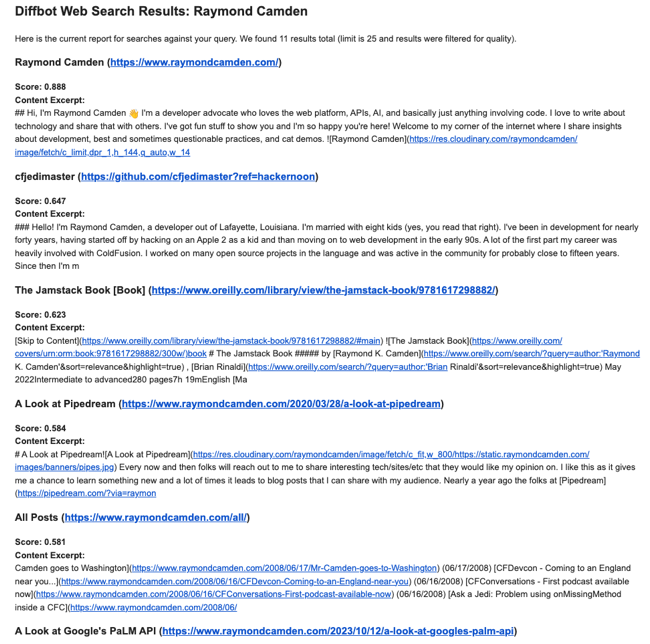
Ok, that's not terribly exciting, but you get the idea. I think where this starts to get cool is in combination with other tools as well. You will probably not be surprised to know this is covered in their AI skills as well, and I'm going to demonstrate that soon as well. Check it out for yourself and let me know what you think!